FLUIDYN–PANACHE - ATMOSPHERIC AIR FLOW & POLLUTANTS DISPERSION
Fluidyn-PANACHE is a software family dedicated to the simulation of atmospheric pollutant dispersion and air quality prediction. Based entirely on a 3D-CFD approach (Computational Fluid Dynamics), the modeling tools can predict with high accuracy the gas/particle dispersion both in the near field and far field. Among all the features, Fluidyn-PANACHE takes into account the effects of buildings, complex topography, land covers, weather conditions, atmospheric boundary layer, transient and chronic emission (gas, particles, dense gas, fire products, 2 phases releases…).
5
MODULES
Fluidyn-PANACHE family is derived into several modules depending on the applications:
-
Fluidyn-PANEPR:
Accidental dispersion modeling (Toxic,Flammable,Radionuclides, Fire products …) -
Fluidyn-PANEIA :
Industrial impact on air quality -
Fluidyn PANROAD:
Road traffic impact
on air quality
-
Fluidyn-PANAIR :
Urban air quality assessment -
Fluidyn PANWIND :
Wind flow simlation in urban areas
Software family for modelling airflow and pollutants dispersion in urban and industrial areas at local micro and urban scale
Airflow, wind pressure at street level on building facades
Consequences of Chemical, Biological, Radiological, Nuclear (CBRN) agents leak
Quantitative Risk Assessment (QRA) of petrochemical products leaks
Environmental Impact Assessment of industrial emissions, odours
Roads, airports pollution impact on sensitive population- hospitals, schools
Urban air quality forecasting from curb side to large cities
Real time forecasting of industrial emissions, odours, traffic pollution impact
Wind energy forecasting for a site before installation and in function
Heat radiation from warehouse, fuel fires in 3D with effect of fire walls, sprinklers
Modelling features: large / small scale dispersion, topography, obstacles effects
Models atmospheric / mechanical turbulence, transient / chronic dispersion
User friendly interface for numerical model construction, meshing and result analysis
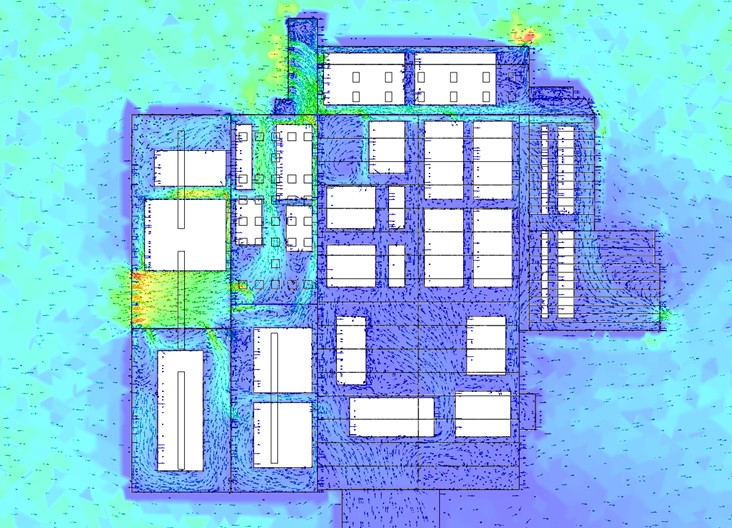
FLUIDYN-PANEPR
fluidyn-PANEPR is the module of fluidyn-PANACHE dedicated to the 3D simulation of accidental dispersion from industrial sites. It analyzes the consequences of accidental dispersion of pollutant discharge in process industries due to rupture or leaks in pressurized or nonpressurized tanks, pipes, valves, joints etc. and combustion products due to fires. fluidyn-PANEPR is a powerful tool which can be used to plan anticipatory measures and solve problems in case of industrial accidents. It integrates the 3D modelling characteristics (wind, turbulence and pollutant transport) of fluidyn-PANACHE and takes into account the influence of topography, obstacles (in near field), and buildings, influence of vegetation and terrain on dispersion, solar radiation effects and ambient atmospheric conditions. It can simulate transient effects of the following physical phenomena: compressible flow, buoyancy effects, atmospheric release interactions, and variable source time.
- Air flow simulation around obstacles and over topography
- Toxic/Flamamble gas dispersion
- Heavy/Hot/Dense releases
- Multiples sources (stacks, point, areas, volume…)
- Fire products dispersion
- Optimization of mitigation measures
- Radionuclides dispersion
- Sensor network optimization
- Acute human health exposure
FLUIDYN-PANEIA: DISPERSION OF INDUSTRIAL EMISSIONS IMPACT STUDIES
fluidyn-PANEIA is a software dedicated to the environmental impact assessment of industrial sites on air quality and health. fluidyn-PANEIA models the atmospheric dispersion of industrial emissions in the air, released from point or continuous sources. fluidyn-PANEIA is a module of fluidyn-PANACHE and integrates its 3D Computational Fluid Dynamics principles for air quality prediction, thus taking into account, topography, obstacles and buildings, influence of vegetation and complex terrain on the dispersion and meteorological parameters, like solar radiation and ambient weather conditions. fluidyn-PANEIA is designed to aid environmental engineers, project managers as well as decision makers to conform or ensure that their industrial sites comply to the statutory directives imposed by the national regulatory bodies for atmospheric air quality and subsequent environmental and health impact.
- Chronic emission modeling over complex terrain
- Gas/Particle atmospheric dispersion modelling
- Odour concentration assessment
- Simulation of the dry and wet deposition around plants
- Optimization of the emission characteristics for impact limitation
- Plume visibilty assessment
- On-site and off-site sensor layout analysis
- Legionella dispersion
- Radionuclides dispersion
- Hourly/Daily/Annualy impact modeling
- Human health short term and long term exposure


FLUIDYN-PANROAD- ROAD TRAFFIC AND INFRASTRUCTURE IMPACT ON AIR QUALITY
fluidyn-PANROAD is the module of fluidyn-PANACHE specially dedicated to simulate the dispersion of pollutants emitted by vehicles on roads and highways, to evaluate air quality and health impact. Designed for highway planners and environmental engineers, fluidynPANROAD evaluates the impact of modifications in existing infrastructures and the environmental impact of upcoming projects. fluidyn-PANROAD helps to determine:
- Traffic pollution modeling over complex terrain at high resolution
- Air quality from the district scale to city level
- Road networks, public transport, tunnel exit, Hourly/Daily/Annualy traffic emissions impact
- Simulation of air quality improvement measures (speed regulation, traffic limitation, road deviation, …)
- Human health exposure assessment
- Regulatory compliance analysis
FLUIDYN-PANAIR - URBAN DEVELOPMENT IMPACT ON AIR QUALITY
fluidyn-PANAIR is a module of fluidyn-PANACHE designed to simulate pollutant dispersion into the atmosphere. It simulates general air quality in various weather conditions, by taking into account low wind velocities and by including the natural convection in the urban canopy. Designed to be used by highway and environmental engineers, it is used to • Assess the impact of any changes in the existing infrastructure • Simulate the effects of pollution due to upcoming projects. • Evaluate the pollution on a regional scale fluidyn-PANAIR has been validated in Europe & East American regions, and can be used when the simulation of the air quality for a congested area is required. It can evaluate the contribution of several multiple kinds of sources to the air pollution, such as vehicles, heat emissions from industries and urban areas. The ozone formation and regional transport can be evaluated by means of different reactive schemes. fluidyn-PANAIR helps to determine:
- Air quality from the street level to city level
- Modelling the contribution of various pollutant source inventories (industry, roads, heating, harbour…)
- Air pollution modeling over complex terrain at high resolution
- Simulation of the urban planning impact on air quality
- Air monitoring sensor layout optimization
- Short term and long term human health exposure assessment
- Regulatory compliance analysis
FLUIDYN-PANWIND
fluidyn-PANWIND is a CFD software dedicated to the 3D air flow modeling in complex urban environment. fluidyn-PANWIND is a module of fluidyn-PANACHE family which includes its main characteristics and allows a quick and accurate simulation of wind flows around buildings or on a regional scale by taking into account: - all kinds of obstacles and architectures - the topography, the influence of terrain and vegetation, the local meteorological conditions.
- Wind flow patterns around buildings and obstacles
- Wind characteristics assessment (direction, average speed, turbulence intensity, pressure on buildings, …)
- Improvement of the pedestrian comfort around buildings
- Local climatology analysis
- Validation of natural ventilation in buildings
- Local wind production assessment for urban wind turbines